Historic masonry does not recognize national borders—but restoration knowledge too often does.
Across the world, craftspeople are confronting many of the same challenges: aging buildings, disappearing trade knowledge, incompatible repairs, changing climates, workforce shortages, and the retirement of experienced restorers.
Yet every country approaches those challenges through its own materials, building traditions, training systems, climates, regulations, and cultural values.
What could we learn if those experiences were shared?
That question is driving my preparation for Masonry Restoration International: Knowledge Without Borders—an initiative intended to connect the people preserving our masonry heritage around the world.
The purpose is not to promote one universal restoration method. There is no single mortar, repair detail, specification, or training model suitable for every building and climate.
The purpose is to create a place where knowledge can travel—and where context travels with it.
What is happening in the United Kingdom?
The UK has a well-established culture of building conservation, with recognized heritage qualifications, specialist masonry pathways, work-based training, and apprenticeships. Historic England’s programs combine mentorship with experience on significant buildings and Heritage at Risk sites.
But even with this infrastructure, its research shows that the supply of traditional building skills is not meeting the underlying need. That should concern every country caring for an aging building stock. (Historic England)
What is happening in Canada?
Canada’s restorers work across enormous regional differences—from historic brick buildings in its cities to stone structures, industrial heritage, and remote historic sites. They must contend with freeze-thaw cycling, moisture, salts, severe temperature changes, and the consequences of modern interventions in older wall systems.
Parks Canada continues to employ heritage craftspeople using traditional masonry and other historic trades. Canada is also investing in training connected to the repair, alteration, and energy performance of existing masonry buildings. (Parks Canada)
What can Australia teach us?
Australian practitioners face distinctive combinations of heat, intense sunlight, coastal salts, moisture, material availability, and the conservation of buildings constructed under very different regional conditions.
Its experience raises important questions about durability, maintenance, compatible materials, and the way imported building traditions were adapted—or sometimes poorly adapted—to local environments.
What is happening in New Zealand?
New Zealand brings another critical dimension to the conversation: seismic risk.
How do we stabilize historic masonry without unnecessarily sacrificing its cultural value or original fabric? How do engineers, conservators, contractors, building owners, and communities work together when life safety and preservation must both be addressed?
New Zealand can also help broaden the discussion beyond European-derived construction traditions. International knowledge exchange must respect Indigenous heritage, cultural authority, and the people to whom historic places belong.
What can we learn from mainland Europe?
There is no single “European approach.” The continent contains an extraordinary range of brick, stone, terracotta, lime, earthen construction, vaulting, render, plaster, and regional craft traditions.
Some countries retain strong apprenticeship, guild, workshop, and craft-school models. Others face the same loss of skilled tradespeople seen elsewhere. European experience can deepen our understanding of traditional materials, conservation philosophy, preventive maintenance, documentation, and the relationship between craft and cultural identity.
ICOMOS has long encouraged international cooperation in conservation education while recognizing that training must respond to the technical and cultural requirements of each region. (ICOMOS)
This is exactly the balance Masonry Restoration International should pursue:
Knowledge without borders—but never without context.
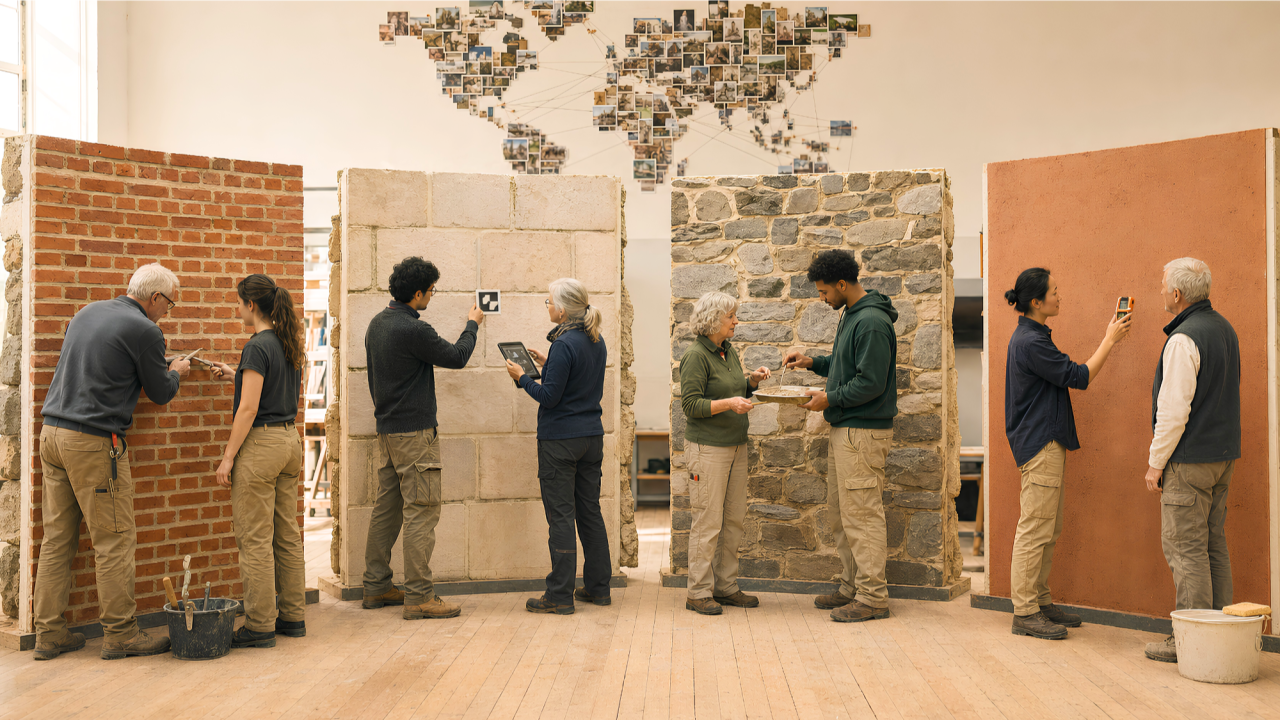
I envision a network where craftspeople, educators, architects, engineers, conservators, researchers, manufacturers, preservation organizations, and building owners can:
• Compare regional restoration practices • Share case studies, failures, and lessons learned • Examine training and apprenticeship models • Discuss traditional and emerging materials • Explore climate adaptation and energy retrofits • Improve communication between the trades and professions • Create opportunities for mentorship and international exchange • Preserve knowledge before it disappears
No country has all the answers.
A repair that succeeds in London may fail in Winnipeg. A seismic intervention developed in New Zealand may inform work elsewhere, but it must still be adapted to the building in front of us. European craft traditions can teach us a great deal, but they cannot simply be transferred without considering local materials, climate, history, and culture.
The goal is not standardization for its own sake.
The goal is better questions, better judgment, stronger training, and more durable, respectful restoration.
Masonry Restoration International: Knowledge Without Borders will begin by listening.
What challenges are restoration professionals facing in your country? What programs are succeeding? Which skills are disappearing? What practices deserve wider attention—and what failures should others avoid repeating?
If you work in historic masonry restoration in the UK, Canada, Australia, New Zealand, mainland Europe, or elsewhere, I want to hear from you.
Our buildings may be local.
Our responsibility to preserve the knowledge needed to care for them is global.
Brick by brick. Stone by stone. Border by border.
