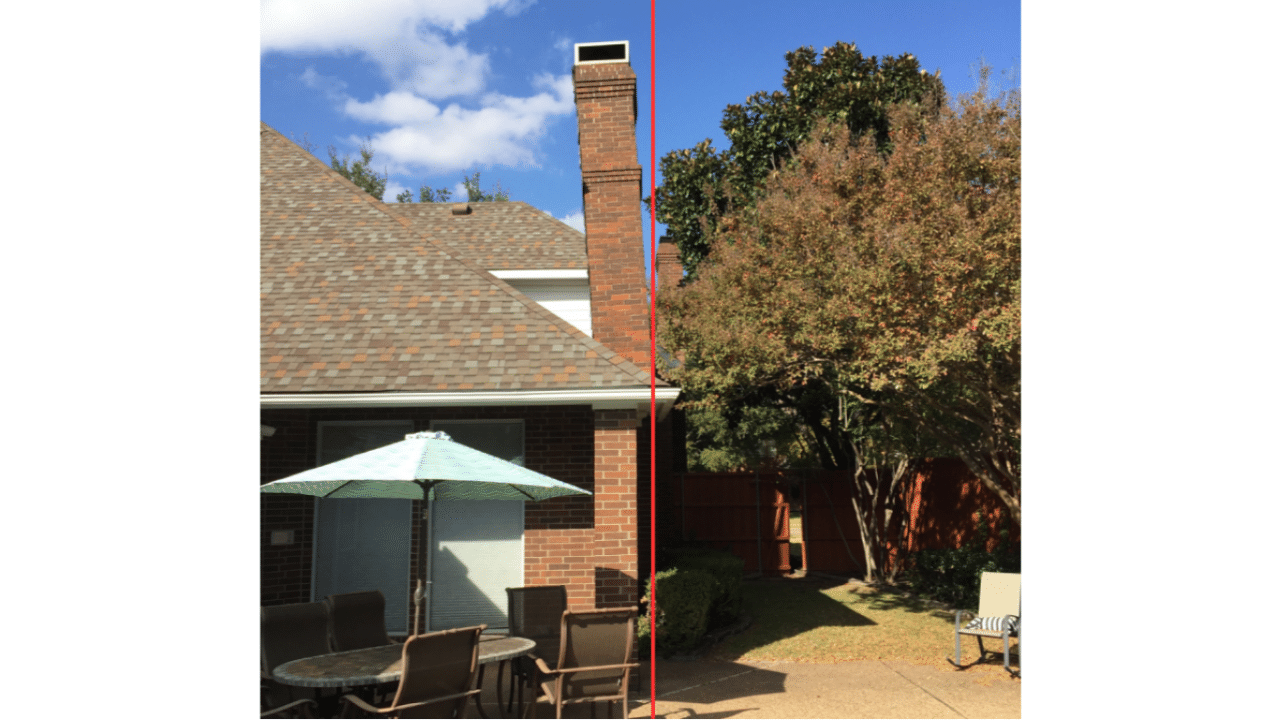

At first glance, this leaning chimney looked like a masonry problem.
It wasn’t.
The brick veneer chimney shown in this photograph had begun rotating toward the house. The red vertical line highlights how far the structure had moved from its original alignment. To many observers, the assumption would be that the brickwork was failing. However, the root cause was concealed behind the masonry.
The brick veneer was supported by an internal wood-framed chimney chase. Over time, water infiltration entered the structure and saturated the timber framing. As the wood deteriorated and lost its structural capacity, the framing began to distort and deform. Because the brick veneer was tied to this framing, the masonry moved with it.
The result was a chimney that gradually rotated toward the roof structure and house.
This type of failure is particularly dangerous because the masonry itself may appear sound. The mortar joints can remain intact, the bricks may show little cracking, and yet the entire assembly is becoming unstable. Engineers and contractors who focus only on the exterior masonry can easily miss the true cause of movement.
Several lessons can be taken from this investigation:
• Masonry is often the victim, not the cause, of structural movement.
• Water intrusion should always be considered when evaluating leaning veneer chimneys.
• Brick veneer relies on its backing structure for support; when the backing fails, the veneer follows.
• Visual inspections alone rarely reveal the complete story.
• Early investigation can prevent a partial or complete collapse.
In this case, the danger was not the brickwork itself but the hidden deterioration of the wood structure behind it. Had the condition remained undetected, continued movement could have led to failure of the veneer, damage to the roof structure, or injury to occupants below.
The most important part of any masonry investigation is understanding what is happening behind the brick. The visible symptom is rarely the real problem. As I often tell clients, if you can only see the brick, you’re only seeing half the structure.