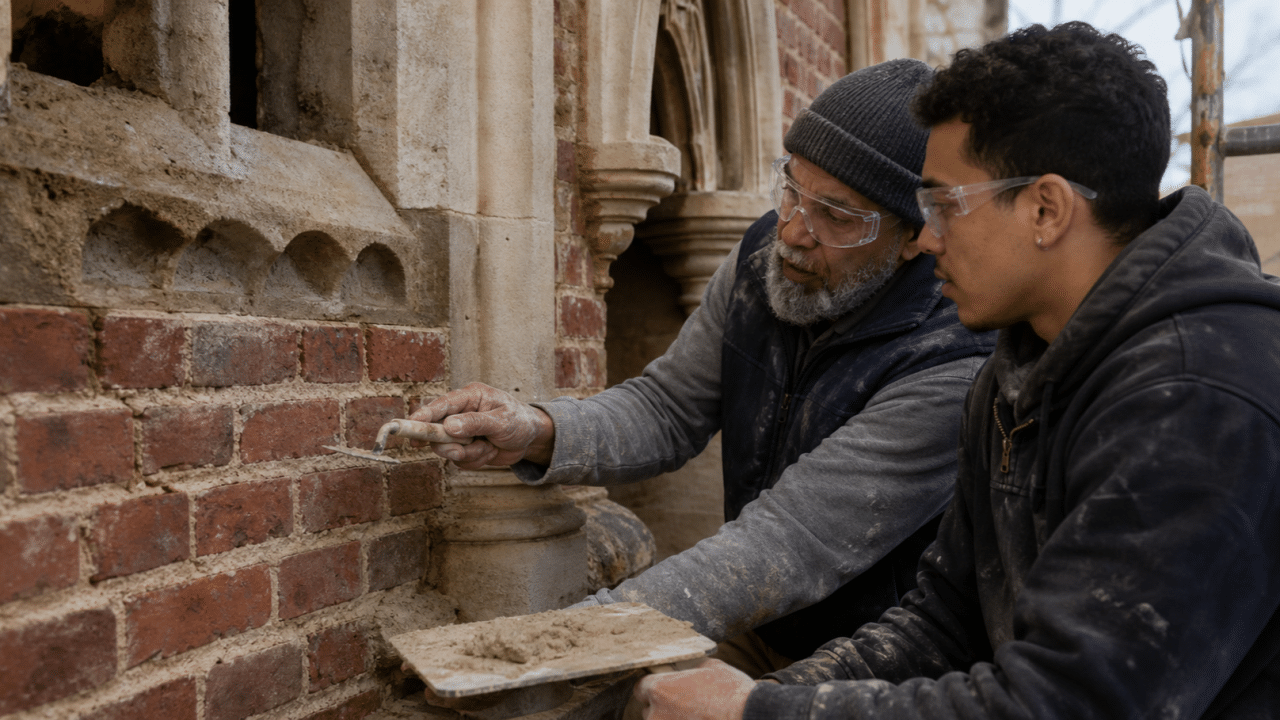
Historic Masonry Restoration Training: More Than a Need: It’s My Mandate
Historic masonry restoration is more than a trade. It is the stewardship of our architectural history.
From grand cathedrals to century-old brick buildings, historic structures connect us to the people who designed, built, and cared for them. Every wall, arch, and façade carries evidence of their skill. But as many of today’s most experienced restoration professionals approach retirement, our industry faces an urgent question:
Who will carry this knowledge forward?
The answer depends on what we do now.
We must preserve more than buildings. We must preserve the knowledge, judgment, and respect for traditional craft that make responsible restoration possible. That means preparing a new generation of professionals to become capable caretakers of our shared architectural heritage.
A Modern Approach to a Traditional Craft
Becoming a historic masonry restorer involves far more than learning to repair brick or stone. It requires an understanding of how historic structures were built, why traditional materials behave as they do, and how an inappropriate repair can cause lasting damage.
For generations, much of this knowledge has been passed informally from one craftsperson to another. That tradition remains invaluable, but it is no longer enough on its own. As the industry undergoes a generational transition, structured training programs are essential.
The strongest programs will bring old and new together: traditional materials and proven craft practices, supported by modern teaching methods and appropriate technology. Innovation should improve accuracy, documentation, and efficiency without compromising historic integrity.
Learning in the Classroom and on the Wall
Effective restoration education must combine knowledge with practice.
Students need a foundation in material science, architectural history, building diagnostics, and traditional masonry methods. Just as importantly, they need supervised experience on real structures, where conditions are rarely as simple as they appear in a textbook.
Classroom learning explains the why. Field experience develops the judgment to determine what to do, when to do it, and how to do it well.
Professional associations, trade organizations, unions, preservation groups, and historic societies all have a role to play. By supporting apprenticeships, workshops, internships, and mentorship opportunities, they can connect emerging restorers with experienced professionals and help turn knowledge into lasting skill.
Mentorship and Lifelong Learning
Historic masonry restoration is both an art and a science, and no one masters it through a single course.
Materials, diagnostic tools, and conservation methods continue to evolve. Restorers must remain curious, keep learning, and know when a time-tested approach is preferable to a new one.
Mentorship is especially important. Veteran craftspeople pass along more than technique; they share the problem-solving instincts and practical wisdom developed over decades in the field. That knowledge cannot be captured fully in a manual. It must be demonstrated, practiced, questioned, and refined.
When we create meaningful pathways for lifelong learning, we strengthen individual careers and the entire restoration profession.
Investing in the Future
Commitment alone will not close the skills gap. Training requires investment.
Quality programs need suitable facilities, authentic materials, knowledgeable instructors, hands-on projects, and access to historic structures. Grants, sponsorships, public funding, and private partnerships can provide the resources necessary to build and sustain these programs.
We must also invest in the people who teach. Developing the next generation of instructors is just as important as training the next generation of restorers. Without capable educators and mentors, hard-earned knowledge may disappear before it can be passed on.
Building a Stronger Restoration Community
No single contractor, school, association, or preservation organization can solve this challenge alone.
The future of historic masonry restoration depends on collaboration at the local, national, and international levels. Sharing best practices, expanding access to training, and bringing greater attention to the shortage of skilled restorers will help the industry move forward with purpose.
When educators, craftspeople, building owners, professional organizations, and preservation advocates work together, we create more than a workforce. We create a community committed to standards, stewardship, and the future of the craft.
A Call to Action
The challenge before us is significant, but so is the opportunity.
By investing in training and mentorship today, we can ensure that historic masonry restoration does more than survive—it can flourish. Every carefully repaired wall and thoughtfully restored façade can become evidence of an unbroken chain of knowledge: from those who built before us to those who will care for these structures long after us.
Whether you are an experienced craftsperson, an educator, an industry supporter, or someone considering a career in restoration, you have a role to play.
For me, this is more than a need. It is a mandate.
The future of historic masonry restoration is our shared responsibility. Let’s build that future together, brick by brick, stone by stone.