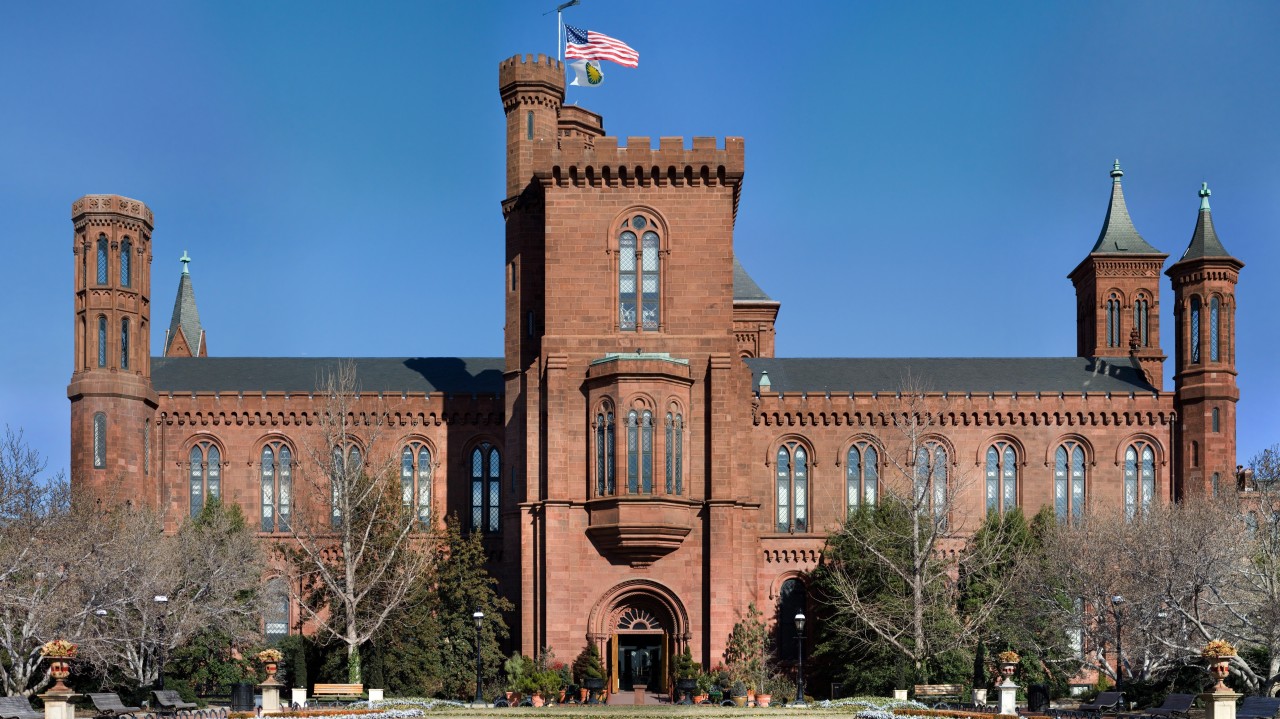
The Smithsonian Institution Building, known as the Castle, on the National Mall.
When we talk about sustainable preservation in construction, the conversation often begins with new materials.
Low-carbon products. More efficient manufacturing. Reduced transportation. Better-performing building systems.
All of these matter.
But the restoration of the Smithsonian Castle in Washington, D.C., suggests another way of thinking about sustainability, one that begins not with what we can manufacture next, but with what we already have.
The Smithsonian Institution Building, universally known as the Castle, was completed in 1855. Now 170 years old, it is undergoing the largest historic preservation project in the Smithsonian Institution’s history. The building needs new mechanical, electrical, plumbing, security and life-safety systems, restoration of its historic sandstone exterior and interiors, and substantial structural work to reduce its seismic vulnerability. (National Museum of African American History)


Construction, temporarily paused while the Castle reopened for America’s 250th anniversary celebrations during summer 2026, is now resuming. (Smithsonian Institution)
There are some extraordinary engineering solutions involved.
But perhaps the most important lesson is surprisingly simple:
Sustainability and preservation are not competing objectives. Done properly, preservation is sustainability.
A building that has already lasted 170 years
The environmental conversation around buildings can become preoccupied with operational efficiency: how much energy a building consumes once occupied.
But every existing building also represents an enormous investment of resources that has already been made.
Stone has been quarried. Timber has been harvested. Brick has been fired. Metals have been mined and processed. Materials have been transported. Craftspeople have shaped and assembled them.
Demolishing a serviceable building discards much of that investment.
Preserving it extends its useful life.

The Smithsonian’s stated ambition for the Castle is particularly striking: the revitalization is intended to prepare the building for a century of further use. (National Museum of African American History)
Think about that for a moment.
A building completed in 1855 is not being treated as an obsolete object that has somehow survived into the 21st century. It is being regarded as an asset capable of serving well into the 22nd.
That changes the sustainability calculation considerably.
And sometimes one building can help preserve another
There is another remarkable example of circular thinking within this project.
The Castle is clad primarily in distinctive red Seneca sandstone. The Maryland quarry that originally supplied the material closed in 1901, creating a problem familiar to anyone working with historic masonry: what happens when the material you need simply isn’t produced anymore?
The answer was found roughly 150 miles away.
First Presbyterian Church in Atlantic City, New Jersey, was built in 1867 using remarkably similar red sandstone. Although the stone came from a different quarry, comparative analysis found near-identical colour, density and weathering characteristics.
The church was being demolished.
Instead of treating its masonry as debris, crews carefully deconstructed the building.
Individual sandstone blocks were surgically removed, categorized, palletized and transported for reuse. The process diverted hundreds of tons of durable material from the waste stream. Once in Washington, stone could be cut, dressed and carved as required for the Castle, with testing used to establish characteristics including strength and porosity.
That is circular construction in perhaps its most literal form.
Stone quarried in the 19th century, used for more than 150 years in one building, can now continue its working life in another.
Its first building may have been lost.
Its material was not.

Sustainability isn’t simply recycling
There is an important distinction here.
Recycling often means breaking a material down and using energy to manufacture something else from it.
Reuse preserves far more of what has already been invested in the material.
A sandstone block doesn’t necessarily need to become aggregate simply because its original building has reached the end of its life.
It can still be a sandstone block.
That requires knowledge, however.
Historic materials cannot simply be harvested from one building and installed indiscriminately in another. Compatibility matters. Geology matters. Porosity, density, strength, weathering characteristics, bedding orientation and previous exposure can all matter.
The Atlantic City stone worked because it was not merely visually similar. It was investigated as a potential restoration material.

This is where preservation knowledge becomes part of the sustainability equation.
Keeping the Castle while changing almost everything around it
The sandstone story is only one part of what makes the Castle project interesting.
Beneath the building, engineers are planning something visitors will never see: seismic base isolation.
The Castle is an unreinforced masonry structure, and the 2011 magnitude 5.8 Virginia earthquake demonstrated its vulnerability, causing cracking and damage to decorative turrets. The new approach effectively creates a plane of separation between the building above and ground movement below, allowing the structure to respond differently during an earthquake. (Facilities Dive)
In other words, rather than fundamentally rebuilding the historic masonry structure to make it behave like a modern building, engineers are modifying the relationship between the historic building and the ground beneath it.
That is a profoundly preservation-minded engineering solution.
And the same philosophy can be seen elsewhere in the project.
New mechanical equipment and infrastructure are being accommodated below grade. The Smithsonian says the new sub-basement and below-grade connections allow support functions to be moved out of historic interiors, returning approximately 50 percent more of the Castle to public use and programming. (Smithsonian Institution)
The building adapts.
The historic fabric remains.

Perhaps we need a broader definition of sustainable construction
We often ask how we can make new construction more sustainable.
Historic preservation asks an equally important question:
How much new construction can we avoid needing in the first place?
The Smithsonian Castle project incorporates several different answers.

Maintain a 170-year-old building rather than replace it.
Reuse historic masonry rather than quarrying or manufacturing a substitute.
Upgrade services rather than declaring an old building functionally obsolete.
Put new infrastructure underground when doing so protects important historic interiors.
Use sophisticated engineering to allow an unreinforced masonry building to survive hazards its original builders could never have designed for.
And when another historic building unfortunately cannot be saved, recognize that its materials may themselves constitute a valuable architectural resource.
None of this is easy.
Deconstruction is slower than demolition. Salvage requires planning. Historic materials require assessment. Retrofitting existing structures demands engineering ingenuity and craftspeople who understand how old buildings actually work.
But perhaps efficiency shouldn’t always be measured by how quickly we can remove something and replace it.
Sometimes the greater achievement is figuring out how little we need to throw away.
The sandstone salvaged from Atlantic City’s First Presbyterian Church illustrates that beautifully. A building that could not continue in its original form is nevertheless contributing to the survival of another 19th-century landmark. As I wrote when the stone was first recovered, the project brings together geology, craftsmanship, sustainability and historic continuity.
Now, as work resumes on the Castle, we can see that principle operating at the scale of the entire project.
The Smithsonian Castle is not being preserved by freezing it in 1855.
It is being preserved by giving it what it needs to survive the next hundred years.
And perhaps that is one of the most useful definitions of sustainable preservation we have:Use what already exists. Understand it. Adapt it carefully. Waste as little as possible. And leave it capable of serving another generation.