
Knowledge Without Borders
The Missing Standard
Why Masonry Restoration in the U.S. Is Still Guesswork
We need to say this clearly—because no one else is.
The United States does not have a true masonry restoration standard.
Yes, we have codes. Yes, we have specifications. Yes, we have guidance documents from organizations like The Masonry Society.
But when it comes to diagnosing and repairing existing masonry failures—there is no unified, enforceable system.
And that gap is costing millions.
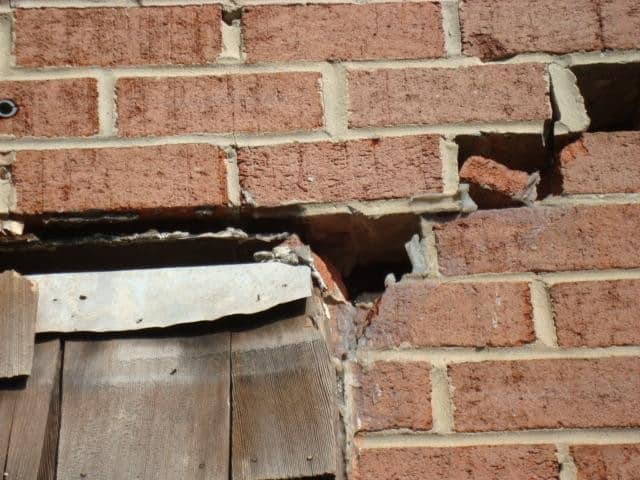
The Illusion of Standards
In new construction, everything is defined:
- Load paths
- Material strengths
- Installation methods
But once a building starts to fail?
Everything becomes interpretation.
One contractor says:
“Repoint it.”
Another says:
“Replace the brick.”
An engineer might say:
“Monitor it.”
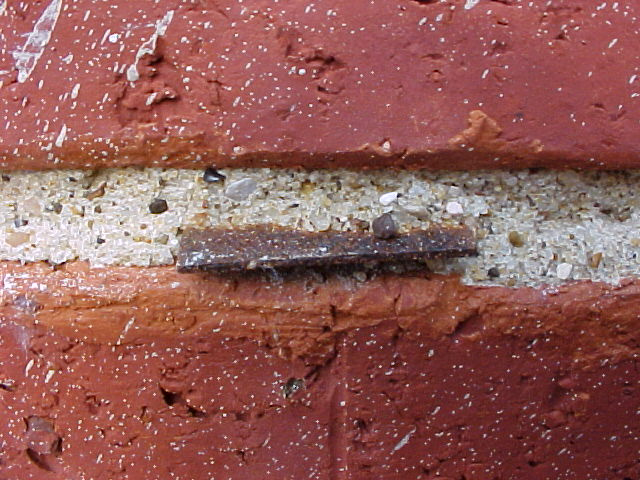
Meanwhile, the actual cause—hidden inside the wall—remains untouched.
The Real Problem: No Diagnostic Standard
The issue isn’t repair techniques.
We have plenty of those.
The issue is this:
There is no standardized method for diagnosing masonry failure in the field.
No required process for:
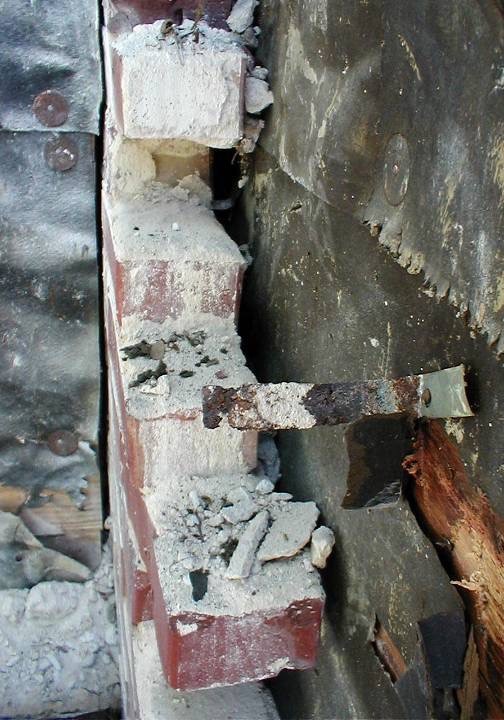
- Investigating cavity wall ties
- Confirming internal corrosion
- Distinguishing structural movement from cosmetic cracking
- Assessing embedded steel
So what happens?
People guess.
And Guessing Is Expensive
Repointing gets done on moving walls. Cracks are filled without understanding why they formed. Corroding steel remains hidden behind fresh mortar.
The building looks better.
For a while.
Then the problem comes back—worse.
What Other Countries Got Right
In the UK, Australia, and New Zealand, there are:
- Defined inspection procedures
- Clear guidance on wall tie failure
- Established remediation strategies
In the U.S.?
We’re still debating whether the problem exists.
The Cost of Getting It Wrong
This isn’t cosmetic.
This is structural.
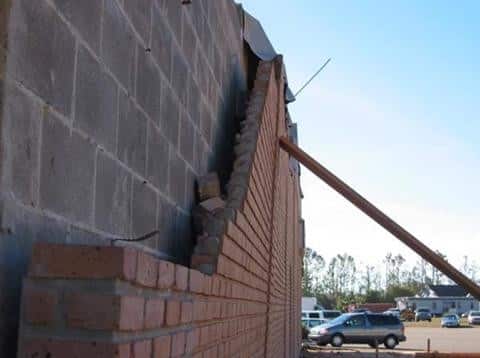
- Veneer collapse
- Falling masonry
- Water ingress leading to hidden decay
- Insurance claims and litigation
All because no one followed a consistent diagnostic process.
The Line That Matters
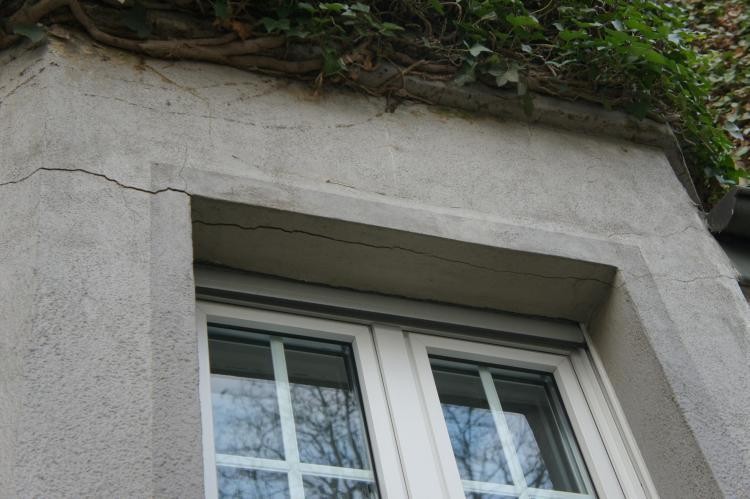
If you don’t have a standard for diagnosis— you don’t have a standard for repair.
Where This Goes Next
This is the first part of this story.
We’re going to break this down properly:
- What we’re missing
- Where failures actually start
- Why repairs keep failing
- And what a real standard should look like
Because until we fix the way we diagnose masonry…
We will keep fixing the wrong problems.
The Standard Gap That’s Costing Millions
Why the U.S. Is Falling Behind on Masonry Wall Tie Inspection and Replacement
The masonry industry in the United States has a serious problem.
Not because we lack repair products. Not because we lack engineering knowledge. And not because masonry failures are rare.
The real problem is this:
The U.S. still does not have a unified, enforceable national standard for inspecting, diagnosing, and replacing failing wall ties in existing masonry construction.
And that gap is costing millions.
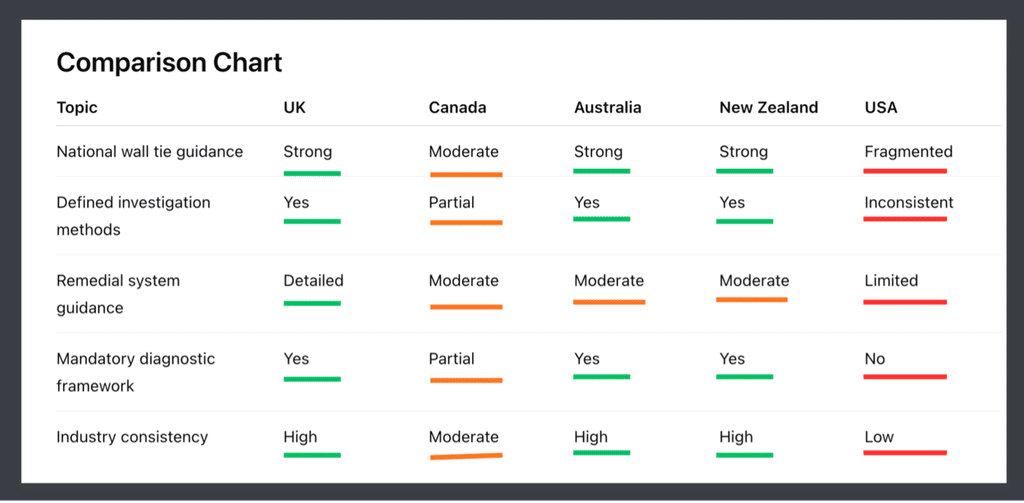
While countries such as the United Kingdom, Australia, New Zealand, and Canada have developed structured guidance for assessing masonry defects and wall tie deterioration, the U.S. approach remains fragmented, inconsistent, and largely dependent on individual opinion.
That should concern every engineer, architect, building owner, and specialized contractor involved in façade assessment and remediation.
Why Wall Ties Matter
Wall ties are not cosmetic components.
They are structural connectors that transfer lateral loads and stabilize masonry veneers and cavity walls.
When they corrode, loosen, or lose embedment:
- Veneers can bulge
- Cracks begin to appear
- Water penetration increases
- Structural instability develops
The problem is often hidden inside the cavity long before visible distress appears externally.
That is why countries with mature masonry industries developed formal investigative procedures decades ago.
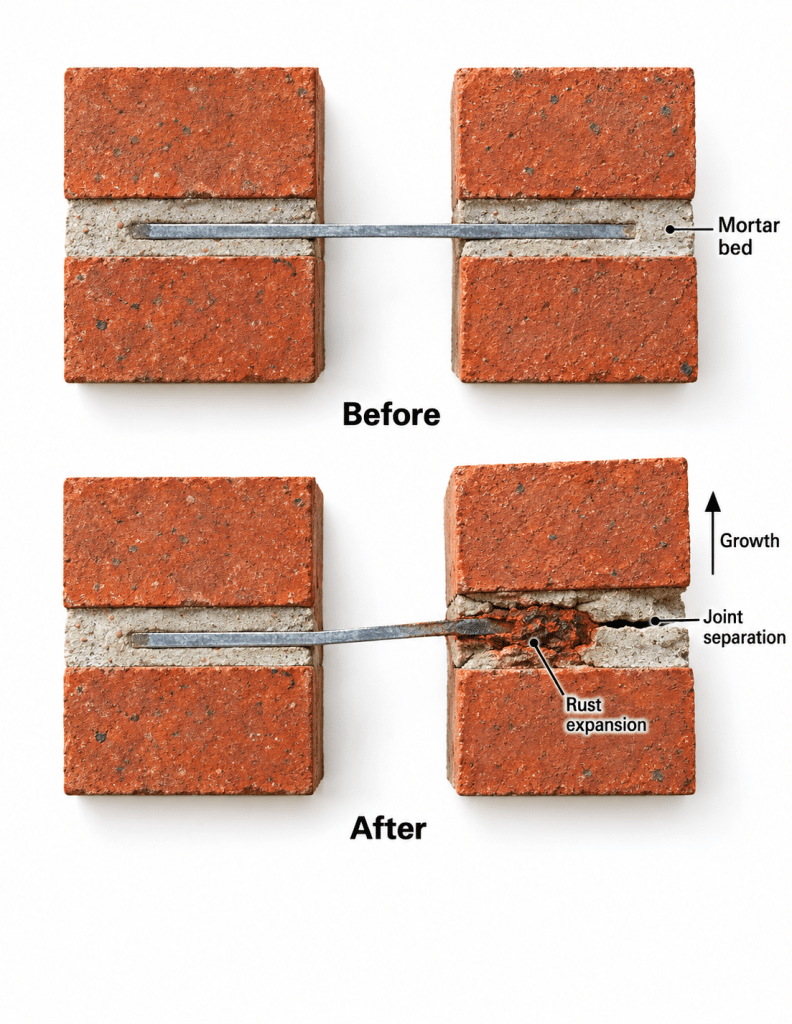
The illustration above shows how a corroded wall tie could cause a defect. The low metal volume of the tie in the USA is not always enough to show a crack on the external wall.
United Kingdom: The Most Developed System
The United Kingdom remains the benchmark for practical wall tie remediation guidance.
Documents such as:
- BRE Digest 329 – Installing Wall Ties in Existing Construction
- BRE Digest 401 – Replacing Wall Ties
provide clear procedures for:
- Investigating cavity wall failures
- Assessing corrosion
- Selecting replacement systems
- Defining installation spacing and embedment requirements
BRE 329 specifically discusses the use of:
- Metal detectors
- Infrared thermography
- Optical probes (borescopes)
- Sampling methods for corrosion assessment
This is not guesswork.
It is a structured process.
The UK also supports these standards through recognized industry guidance and installation protocols from preservation and structural repair organizations.
Canada: Practical Investigation Guidance
Canada recognized cavity wall performance issues decades ago through the Canadian Building Digest series and CMHC guidance.
CBD 21 – Cavity Walls identified:
- The importance of cavity drainage
- Wall tie performance
- Moisture management in masonry systems
Canadian guidance tends to focus heavily on:
- Durability
- Freeze-thaw exposure
- Inspection procedures where corrosion risk exists
While Canada’s system is not as prescriptive as the UK, it still provides a far more organized framework than the U.S. currently has.
Australia: Engineering-Based Masonry Standards
Australia approaches masonry through engineering performance standards, including:
- AS 3700 – Masonry Structures
- AS 4773 – Masonry in Small Buildings
- AS 4773.2 – Assessment of Masonry Structures
These standards provide:
- Design criteria
- Assessment procedures
- Performance requirements
- Investigation methods for existing masonry
Australia places significant emphasis on:
- Structural assessment
- Durability
- Proper tie embedment
- Corrosion resistance
The standards are integrated into broader engineering practice, creating more consistency across the industry.
New Zealand: Integrated Masonry and Timber Standards
New Zealand has one of the most coordinated systems for masonry construction and assessment.
Key standards include:
- NZS 4230 – Design of Reinforced Concrete Masonry Structures
- NZS 4210 – Masonry Construction: Materials and Workmanship
- NZS 3604 – Timber-Framed Buildings
NZS 4230 establishes design and detailing requirements for reinforced masonry structures and incorporates seismic performance considerations.
NZS 4210 defines workmanship and material standards for masonry construction used alongside NZS 4230 and NZS 3604.
New Zealand’s system is notable because it links:
- Masonry design
- Timber interfaces
- Moisture management
- Structural performance
into one coordinated framework.
That level of integration is largely missing in the United States.
The United States: Fragmented and Reactive
The U.S. does have organizations such as The Masonry Society discussing corrosion and façade assessment.
There are:
- Technical notes
- Commentary documents
- Engineering recommendations
But there is no nationally enforced process defining:
- When to inspect
- How to inspect
- How many samples to take
- What failure threshold requires replacement
- Which systems should be used
That leaves critical decisions to:
- Individual consultants
- Contractors
- Manufacturers
- Regional practice habits
The result?
- Inconsistent repairs
- Repeat failures
- Conflicting reports
- Higher long-term costs
Final Thought
The United States does not need more cosmetic repairs.
It needs a diagnostic standard that forces the industry to:
- Investigate internally
- Verify failures
- Match repair to cause
- Document evidence properly
Because without that:
We are not repairing masonry. We are managing symptoms.
And eventually, the wall always wins.
In the comments section below, tell us how wall ties are inspected and regulated.