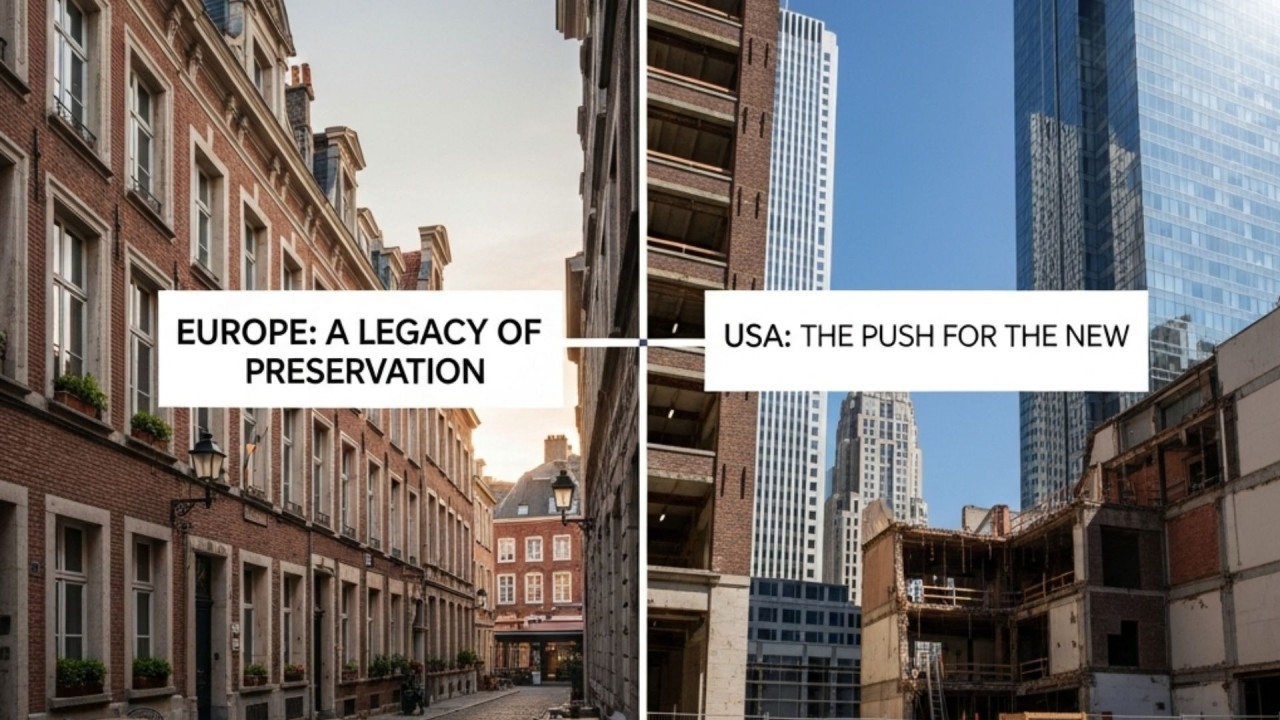
Why Masonry Restoration Takes a Backseat in the U.S.
The American Anomaly: While historic stone and brick buildings are treasured landmarks, the practice of restoring them is significantly less common in the United States compared to many other parts of the world, particularly Europe. This disparity isn’t due to a single cause but rather a complex interplay of historical construction trends, cultural values, economic realities, and the skilled labor landscape.
A Nation Built on Wood
From its earliest days, the United States has favored wood as its primary building material. The vast abundance of forests and a relative scarcity of skilled masons in the colonial era and during westward expansion made wood-frame construction the quicker, cheaper, and more practical choice. This legacy endures today, with wood framing remaining the dominant method for residential and low-rise commercial buildings. Consequently, the sheer volume of masonry structures in the U.S. is considerably lower than in Europe, where centuries of building traditions were firmly rooted in stone and brick.
The age of the building stock also plays a crucial role. European cities and countrysides are dotted with structures that are hundreds, and in some cases, over a thousand years old. In contrast, the majority of the building stock in the United States was constructed in the 20th and 21st centuries. This relative youth means there are simply fewer centuries-old masonry buildings in need of the kind of intensive restoration seen across the Atlantic.
A Culture of “Out with the Old, In with the New”
Underpinning the physical differences in building stock are divergent cultural attitudes towards preservation. Europe, with its long and layered history, places a profound cultural emphasis on its architectural heritage. This is visibly reflected in the number of UNESCO World Heritage Sites: Europe is home to over 500, while the United States has just 25. European governments and local communities often have deeply ingrained policies and a strong social consensus that favor the preservation and adaptive reuse of historic buildings.

The United States, on the other hand, has historically been driven by a ethos of progress and innovation, which has sometimes translated into a preference for new construction over the preservation of older structures. While the historic preservation movement has gained significant traction in the U.S. over the last half-century, it often contends with powerful economic and development pressures that prioritize new builds.
The Economic Equation: Restoration vs. New Construction
Contrary to what one might assume, restoring a masonry building in the U.S. can often be more expensive than building a new one. The primary driver of this cost is the high price of skilled labor. Masonry restoration is a craft that requires specialized knowledge and is labor-intensive. In the U.S., the wages for skilled masons are substantial, making up a significant portion of the overall cost of a restoration project.

The Dwindling Ranks of Skilled Masons
The availability of skilled labor is a critical component. In the United States, the number of skilled masons has been in decline for decades. The U.S. Bureau of Labor Statistics projects a slower than average growth for the profession, and the current workforce is aging. In 2024, there were approximately 294,300 masonry workers in the U.S., with a median annual salary of around $56,600. While Europe also faces challenges with shortages of skilled trade workers, the tradition of apprenticeships and vocational training for masonry remains more robust in many countries. This established pipeline for training new generations of craftspeople helps to ensure that the specialized skills required for high-quality restoration are more readily available than in the United States. The scarcity of these skills in the U.S. not only drives up the cost but can also impact the quality and feasibility of large-scale restoration projects.
In conclusion, the less frequent practice of masonry restoration in the United States is a multifaceted issue. It is a legacy of the nations building history, a reflection of its cultural priorities, a consequence of its economic structure, and a result of the state of its skilled labor force. While the appreciation for historic masonry is growing in the U.S., the convergence of these factors continues to make new construction the more common path.