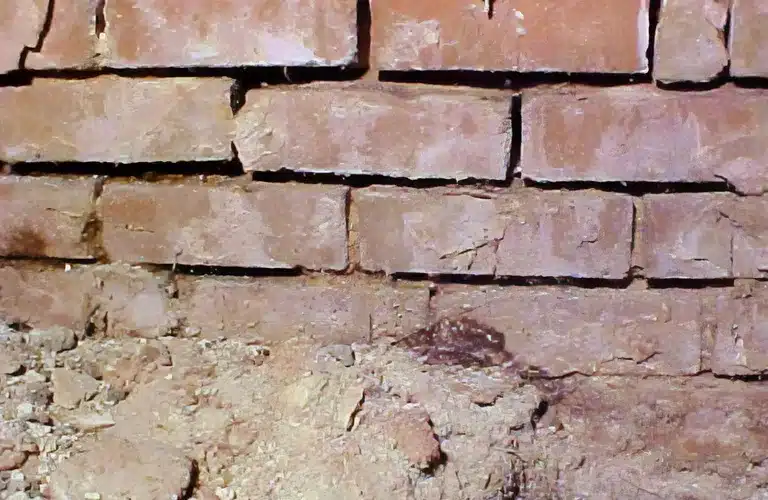
Why the obvious repair is often the wrong one
A crack appears in a brick wall. Someone repoints it. The crack returns.
The next repair may involve replacing a few bricks, perhaps introducing reinforcement, or applying a different mortar. For a while, everything looks satisfactory.
Then the wall moves again.
This is a familiar sequence in masonry restoration, and it raises an uncomfortable question. Was the original problem ever properly understood?
Masonry rarely fails without warning. Deterioration can develop over decades, sometimes concealed within a wall that appears perfectly sound from the outside. By the time cracking, bulging, staining, or displacement becomes visible, the underlying mechanism may have been at work for years.
The difficulty is that similar symptoms can arise from very different causes.
A crack might indicate structural movement. It might also be associated with moisture deterioration, corrosion of concealed metalwork, or an incompatible repair material. Treating every crack as evidence of settlement is no more reliable than assuming that every damp wall has rising damp.
The visible damage is where the investigation begins.
What do we mean by a failure pattern?
Buildings respond to forces acting upon them. Loads are transferred, materials expand and contract, moisture moves, metals corrode, and connections deteriorate.
These processes are not random, although their effects may initially appear so.
A failure pattern is the sequence through which one or more of these processes produces deterioration within a masonry assembly. Recognising that sequence can help distinguish the cause of damage from its consequences.
It also changes the questions we ask.
Instead of immediately deciding how to repair a crack, we need to establish why it formed, whether movement is continuing, and what might happen if the underlying condition remains unchanged.
Five recurring patterns illustrate why that distinction matters.
1. When concealed wall ties begin to fail
A brick veneer can appear remarkably stable even as the connections holding it to the backing structure deteriorate.
Steel wall ties are concealed within the masonry. Their condition is not usually apparent from a routine visual inspection, and corrosion can progress for years before external symptoms become noticeable.
Eventually, the evidence begins to emerge.
Horizontal cracks develop along mortar beds. Sections of veneer may bulge outward. Step cracking appears around openings, or bricks become displaced near floor levels.
These symptoms are sometimes attributed to settlement, thermal movement, or ageing mortar.
But consider what is happening inside the wall.
As steel ties corrode, their effective cross-sectional area diminishes, reducing their ability to provide restraint. Corrosion products can also occupy more volume than the original steel, exerting pressure on surrounding mortar and masonry.
The result can be a combination of fractured joints and progressively weakened connections between the veneer and its supporting structure.
Repointing may improve the appearance of the wall. Replacing damaged bricks may remove some of the visible evidence.
Neither operation, by itself, restores restraint that has been lost through tie corrosion.
The condition of the concealed connections must be established before an appropriate repair can be designed.
[Related resources: Wall Tie Failure Case Studies | Wall Tie Diagnostics]
2. A wall that has lost its restraint
Not every moving wall is suffering from foundation settlement.
Some walls move because the restraint intended to hold them in position is inadequate, has deteriorated, or is missing altogether.
The distinction matters.
Masonry walls depend upon their structural arrangement to resist the forces acting on them. Where lateral restraint is insufficient, outward movement may develop gradually.
A parapet begins to lean. A wall bows. Cracks widen over time, or separation becomes apparent where masonry meets a floor or roof.
Such conditions may be dismissed as historic movement, acceptable tolerance, or non-structural cracking.
Perhaps the movement is longstanding. That does not establish that it has stopped, or that the wall remains adequately restrained.
The critical issue is the load path: how forces are transferred through the building and what prevents the masonry from moving beyond its intended position.
Wind, vibration, or moisture saturation may accelerate displacement in an already vulnerable assembly.
A fresh coat of render or carefully executed pointing can conceal the evidence without changing the structural condition.
And a wall does not become stable simply because its cracks are no longer visible.
[Related resources: Lateral Restraint Case Studies | Structural Stabilization Methods]
3. The mortar is stronger. The masonry is worse.
This is one of the more frustrating failures encountered in historic masonry.
A building survives for generations with relatively little deterioration. It is then repointed using a modern, high-strength mortar, presumably with the intention of making the joints more durable.
Some years later, the brick faces begin to break down.
The mortar may remain comparatively intact while the masonry units around it deteriorate.
What went wrong?
Historic masonry assemblies often depend upon a relationship between the physical properties of the units and their bedding mortar. In many traditional constructions, the mortar is intended to be more accommodating and sacrificial than the masonry itself.
Introduce a mortar that is excessively hard or insufficiently permeable for the surrounding materials, and that relationship changes.
Moisture movement may be restricted. Stresses can become concentrated within the bricks or stone rather than being accommodated by the joints. Freeze-thaw action and salt crystallisation may then contribute to progressive material loss.
The resulting damage is sometimes blamed on poor workmanship or inferior historic materials.
Yet the original masonry may have performed adequately for a century or more before the incompatible intervention.
Repointing again with a similar high-strength mortar merely repeats the mistake.
The appropriate question is not how strong a mortar can be made, but what properties are compatible with the masonry in which it will be used.
[Related resources: Historic Mortar Case Studies | Mortar Compatibility]
4. When moisture damage is mistaken for structural failure
Water has a remarkable ability to complicate masonry diagnosis.
Efflorescence appears on a wall. Mortar begins to crumble. Damp patches develop internally, perhaps accompanied by isolated cracking around an opening or near ground level.
The immediate suspicion may be foundation movement or some other structural defect.
Sometimes that suspicion is justified.
Sometimes the principal problem is moisture.
Water may be entering through defective flashing, accumulating because weep systems are blocked, or moving through the masonry assembly in ways that have not been adequately understood.
Over time, persistent moisture can contribute to material deterioration. Cracking and loss of mortar may follow.
The visible damage can resemble structural distress even where significant structural movement is absent.
This is why the source and movement of moisture must be investigated rather than assumed.
Installing reinforcement will not repair defective flashing. Stabilising a wall does not necessarily stop water entering it. And replacing deteriorated mortar without addressing persistent wetting may leave the conditions responsible for the original damage unchanged.
There is another complication: moisture-related deterioration and structural movement can coexist.
One diagnosis does not automatically exclude the other.
The investigation must establish what is happening in the particular building, rather than selecting the most convenient explanation.
[Related resources: Moisture Failure Case Studies | Rising Damp Investigations]
5. Chimneys, parapets, and the vulnerability of slender masonry
A leaning chimney is easy to notice.
What is less obvious is why it has moved, whether the movement is continuing, and how much stability remains.
Tall, slender masonry elements are particularly sensitive to changes in their support and restraint. Foundation movement, deteriorating connections, and progressive material loss can all contribute to instability.
Cracking at roof level may be one of the first visible indications. Separation from the main structure can follow, sometimes accompanied by a pronounced lean.
It is tempting to describe such conditions as cosmetic, especially where the chimney has apparently stood in the same position for many years.
But appearance alone cannot establish stability.
Once movement develops in a vulnerable vertical element, deterioration may accelerate. The consequences can be serious, particularly where falling masonry threatens occupied areas or public spaces.
Patching the cracks may make the chimney look better.
It does not necessarily make it safer.
The cause of movement, the adequacy of support, and the condition of the remaining restraint must be assessed before deciding whether repair, stabilisation, or replacement is appropriate.
[Related resources: Chimney Stabilization Case Studies | Vertical Element Stabilization]
Why repairs keep failing
These five patterns involve different mechanisms, yet they reveal a recurring problem in restoration practice.
The intervention is often selected before the cause of deterioration has been established.
A crack is filled because it is visible. A damaged brick is replaced because its condition is obvious. A wall is reinforced because movement is suspected.
Sometimes those actions are appropriate.
But the effectiveness of any repair depends upon whether it addresses the mechanism responsible for the damage.
Consider two walls displaying similar cracking. One has lost restraint because concealed steel ties have corroded. The other is experiencing deterioration associated with persistent moisture.
Their external appearance may be comparable. Their repair requirements are not.
Failure pattern recognition helps determine whether a structure can be repaired, whether stabilisation is necessary, or whether deterioration has progressed to the point where replacement must be considered.
It can also prevent unnecessary intervention.
Not every defect requires extensive structural work. Not every damaged masonry unit indicates an unstable building.
The challenge is knowing the difference.
Investigation before intervention
There is no substitute for examining the building.
That may involve targeted opening-up work to expose concealed connections, material analysis, monitoring of cracks and displacement, or reviewing historic construction details.
Remote inspection and drone photography can be valuable where access is difficult, particularly for chimneys, parapets, and high-level masonry.
Each method provides a different part of the picture.
A photograph records a condition at a particular moment. Movement monitoring helps establish whether displacement is continuing. Opening up a wall may reveal deterioration that could never have been confirmed from its external appearance.
The appropriate combination depends upon the suspected mechanism and the consequences of failure.
The purpose is not to investigate endlessly. It is to obtain enough reliable evidence to make a defensible decision about the intervention required.
When another repair is not the answer
There are circumstances in which a more detailed failure-focused review becomes particularly important.
Repeated cracking after previous repairs is one. Progressive movement is another.
Premature failure of an earlier intervention should prompt questions about the original diagnosis, especially where the same symptoms continue to return.
Disagreement about the cause of deterioration also deserves attention. So does uncertainty over which elements provide structural support or restraint.
In each case, proceeding directly to another repair risks obscuring evidence that may be needed to understand the problem.
The cost of investigation must be considered, certainly. But so must the cost of repairing the wrong thing.
Read the building before repairing it
Masonry buildings carry evidence of their own deterioration.
The difficulty is learning to interpret it.
A crack is not a diagnosis. Neither is a bulge, a damp patch, or a leaning chimney. Each is an observation that needs to be considered alongside the construction, materials, exposure, history, and structural behaviour of the building.
Successful restoration begins with understanding those relationships.
Otherwise, even a beautifully executed repair may be little more than a temporary disguise.
Concerned about recurring masonry deterioration?
Masonry Restoration International examines failure mechanisms, diagnostic methods, and documented case studies to help professionals understand what is happening before specifying an intervention.